MLOps Fundamentals: Understanding the Complete Model Development Lifecycle
The $50 Million Jupyter Notebook
What this covers
- The $50 Million Jupyter Notebook
- What Is MLOps, Really?
- The Model Development Lifecycle: Six Phases That Matter
- Why Traditional DevOps Isn't Enough
- The Three Pillars: CI/CD/CT
- Governance: Not a Checkbox, But a Foundation
- How mCloud Technology Can Help
- The MLOps Ecosystem: Tools You Should Know
- Success Metrics: What Good Looks Like
- Conclusion: From Chaos to Systematic Excellence
- References & Further Reading
"The difference between a machine learning experiment and a production ML system is like the difference between a recipe scribbled on a napkin and a commercial kitchen that serves 10,000 meals a day. One is creative chaos; the other is systematic excellence."
The $50 Million Jupyter Notebook
In 2018, a major financial institution discovered a problem with their fraud detection model. The model had been deployed for two years, processing millions of transactions daily. It was sophisticated—a deep neural network trained on years of historical data, carefully tuned by their best data scientists.
Then a regulator asked a simple question: "Can you show us how this model makes decisions?"
The answer should have been straightforward. But it wasn't.
The original data scientist who built the model had left the company. The training code existed somewhere in a Git repository, but nobody was certain which version matched production. The training data? Scattered across three S3 buckets with unclear lineage. The hyperparameters? "Probably in a notebook somewhere," the team said.
After six months and $50 million spent reconstructing the model's provenance, the institution learned a painful lesson: a machine learning model without a development lifecycle isn't an asset—it's a liability.
This story isn't unique. We see variations of it across industries:
A healthcare company can't reproduce a clinical trial model for FDA approval
A retail company loses confidence in their pricing algorithm but can't safely replace it
A tech startup's recommendation engine drifts for months before anyone notices
The common thread? These organizations treated machine learning like a research project instead of an engineering discipline.
That's what MLOps solves.
What Is MLOps, Really?
MLOps—Machine Learning Operations—is the set of practices that brings engineering rigor to the entire machine learning lifecycle, from data preparation through model deployment to ongoing monitoring.
But that definition doesn't capture what MLOps truly represents: a philosophical shift from "models as experiments" to "models as products."
The Philosophy: Continuous Learning Under Governance
Traditional software is deterministic. If you deploy version 1.2.3 of your application, you know exactly how it behaves. It will process the same input the same way every time. When you want to improve it, you change the code, test it, and deploy.
Machine learning is fundamentally different. Models are probabilistic and data-dependent:
The same code with different data produces different models
Models degrade over time as the world changes (data drift)
"Testing" isn't just unit tests—it's statistical evaluation on holdout data
"Deployment" isn't the end—it's the beginning of continuous evaluation
This creates unique challenges that traditional DevOps wasn't designed to handle:
Traditional DevOps | MLOps |
Code versioning (Git) | Code + data + model versioning |
Deterministic testing | Statistical evaluation + bias testing |
Deploy once, runs forever | Deploy, monitor drift, retrain continuously |
Code review before merge | Code + model + fairness review |
Performance = speed/uptime | Performance = accuracy + latency + cost + fairness |
Rollback = revert code | Rollback = revert model + retrain from checkpoint |
The MLOps Insight: You're not just managing code deployments—you're managing a continuous learning system that must remain accurate, fair, and compliant as the world evolves.
The Core Definition
At mCloud, we define MLOps as:
"The practice of deploying, monitoring, and maintaining machine learning models in production environments with the same reliability, scalability, and governance as mission-critical software systems—while embracing the unique challenges of data dependency, model drift, and probabilistic behavior."
This means three things:
Models are never "done" - They require continuous monitoring and retraining
Data is as important as code - Data quality, lineage, and drift must be managed systematically
Governance is built in, not bolted on - Compliance, explainability, and fairness are embedded in the lifecycle
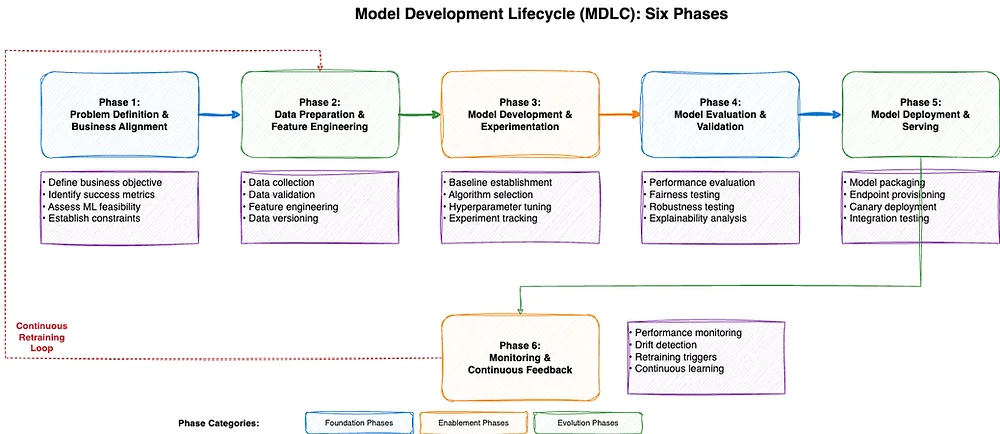
The Model Development Lifecycle: Six Phases That Matter
The Model Development Lifecycle (MDLC) is the foundation of MLOps. It's a structured approach that ensures every model progresses from idea to production with repeatability, transparency, and accountability.
Think of MDLC as the manufacturing process for ML models. Just as a car factory has defined stages (design → prototype → testing → assembly → quality control → delivery),
ML models need a systematic progression.
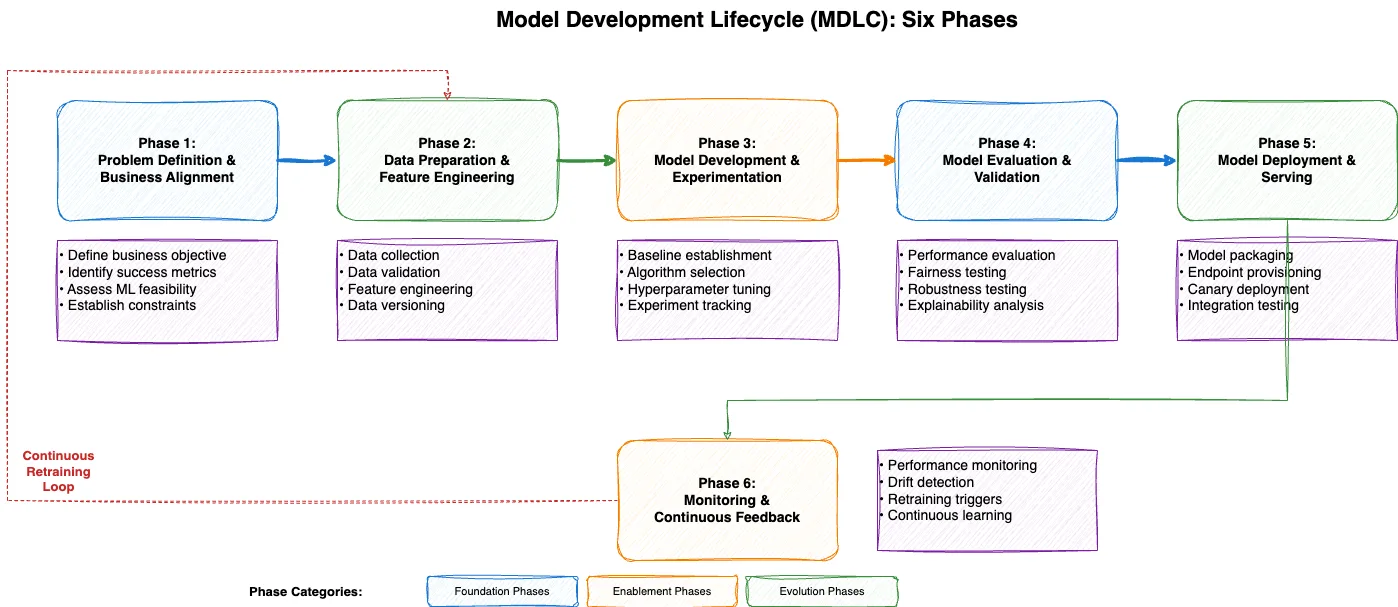
Here are the six phases that every production model must go through:
Phase 1: Problem Definition & Business Alignment
The Question: What are we actually trying to solve, and is ML the right tool?
Why It Matters: Most ML projects fail not because of technical challenges, but because they solve the wrong problem. We've seen teams spend months building a 95% accurate model only to discover the business needed 99% accuracy—or that a simple rules-based system would have sufficed.
What Happens Here:
Define business objective: Not "build a recommendation engine," but "increase user engagement by 10%"
Identify success metrics: What does "good enough" look like? What's the business impact?
Assess ML feasibility: Is there enough data? Is the problem predictable? Is ML necessary?
Establish constraints: Latency requirements, cost limits, regulatory requirements
Key Deliverables:
Problem statement document
Success criteria (quantitative)
Data availability assessment
Feasibility analysis
Real-World Example:
A healthcare provider wanted to "predict patient readmissions." After problem definition workshops, we clarified: they needed a model that identifies the top 10% of high-risk patients within 24 hours of discharge for outreach intervention. This specificity changed everything—from the feature set (no lab results available post-discharge) to the success metric (precision at top 10%, not overall accuracy).
Common Pitfalls:
❌ "Build an AI to improve X" (vague objective)
❌ Skipping feasibility analysis (discovering too late there's insufficient data)
❌ No business metric (optimizing accuracy instead of business value)
Tools & Frameworks:
Business case templates
Feasibility assessment checklists
Data readiness evaluation frameworks
Phase 2: Data Preparation & Feature Engineering
The Question: How do we transform raw data into features that models can learn from?
Why It Matters: "Applied machine learning is basically feature engineering." Even the most sophisticated algorithm can't extract signal from messy, irrelevant, or biased data.
What Happens Here:
Data collection: Gather raw data from source systems (databases, APIs, logs, sensors)
Data validation: Check schema conformance, missing values, outliers, distribution shifts
Data cleaning: Handle nulls, duplicates, errors
Feature engineering: Transform raw data into meaningful model inputs
Feature validation: Test features for leakage, bias, and predictive power
Data versioning: Create reproducible snapshots of training/test datasets
Key Deliverables:
Versioned training and test datasets
Feature definitions and documentation
Data quality reports
Exploratory data analysis (EDA) notebooks
Real-World Example: A retail company building a demand forecasting model discovered their "product_price" feature had errors—some prices were in dollars, others in cents. This data quality issue went unnoticed for months because the model "worked" (training accuracy looked good), but predictions were wildly wrong for the misencoded products. After implementing automated data validation (using Great Expectations[^1]), they caught similar issues in days instead of months.
The Feature Store Revolution: Modern MLOps practice uses feature stores to centralize feature engineering:
Define features once, reuse everywhere: "customer_lifetime_value" computed consistently across models
Serve features online and offline: Same features in training and production (eliminates training-serving skew)
Track feature lineage: Know which raw data produced which features
Popular feature stores include Feast[^2], Tecton, and cloud-managed solutions (AWS SageMaker Feature Store, Google Vertex AI Feature Store).
Common Pitfalls:
❌ Data leakage: Using future information in training (e.g., including "payment_received" to predict default)
❌ Training-serving skew: Features computed differently in training vs. production
❌ No versioning: Can't reproduce training data, can't debug production issues
Tools & Technologies:
Data validation: Great Expectations, Deequ, TensorFlow Data Validation
Data versioning: DVC (Data Version Control), Delta Lake, Apache Iceberg
ETL/ELT: Apache Spark, dbt, AWS Glue
Phase 3: Model Development & Experimentation
The Question: Which model architecture and hyperparameters best solve our problem?
Why It Matters: This is the phase most people associate with "doing machine learning"—training models, tuning hyperparameters, comparing algorithms. But without systematic experimentation tracking, this becomes trial-and-error chaos.
What Happens Here:
Baseline establishment: Start with simple models (logistic regression, decision trees) to set baseline performance
Algorithm selection: Test multiple approaches (traditional ML, deep learning, ensemble methods)
Hyperparameter tuning: Optimize model configuration (learning rate, regularization, architecture)
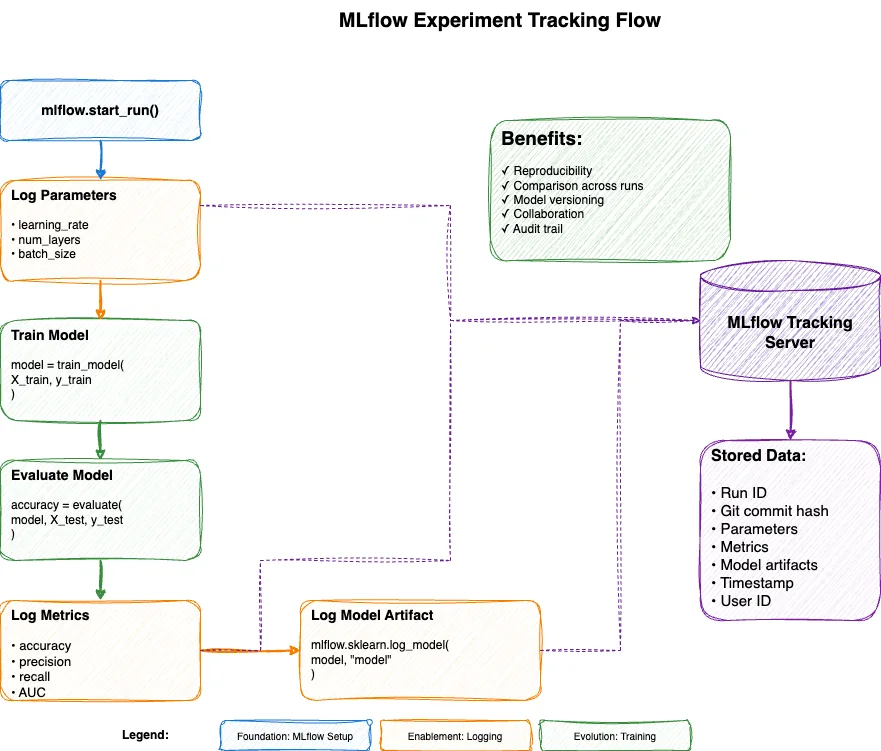
Experiment tracking: Log every experiment with code version, hyperparameters, metrics, and artifacts
Model comparison: Systematically evaluate which approach works best
Key Deliverables:
Trained model candidates (multiple versions)
Experiment tracking logs (MLflow, Weights & Biases)
Model performance reports
Selected champion model for evaluation
The Experiment Tracking Imperative:
Without experiment tracking, data scientists lose track of what they've tried:
"What hyperparameters gave us 0.89 AUC three weeks ago?"
"Which dataset version was used for the model in staging?"
"Why did this experiment work better than others?"
Modern MLOps practice mandates automatic experiment tracking for every training run using tools like MLflow:
Real-World Example: A data science team at a fintech company ran 300+ experiments over 3 months to optimize a loan approval model. Initially, they tracked experiments in a shared spreadsheet. By month two, the spreadsheet was a mess—duplicate entries, missing details, no model artifacts saved.
After implementing MLflow experiment tracking:
Every experiment automatically logged with git commit hash, dataset version, hyperparameters, and metrics
Team could reproduce any historical experiment in minutes
Model comparison became trivial (query MLflow for "show me all experiments with AUC > 0.85")
Collaboration improved (team members could see each other's experiments)
Common Pitfalls:
❌ Notebook chaos: Experiments scattered across dozens of notebooks with no organization
❌ Overfitting: Optimizing on test set instead of holdout validation set
❌ No reproducibility: Can't recreate a model result from last month
❌ Metric tunnel vision: Optimizing accuracy without considering fairness, latency, or cost
Tools & Technologies:
Experiment tracking: MLflow, Weights & Biases, Neptune.ai, Comet
Training frameworks: Scikit-learn, TensorFlow, PyTorch, XGBoost, LightGBM
Distributed training: Ray, Horovod, PyTorch Distributed
Phase 4: Model Evaluation & Validation
The Question: Is this model good enough to deploy, and how do we know?
Why It Matters: A model might have 95% accuracy in training but fail catastrophically in production due to bias, poor calibration, or sensitivity to edge cases. Rigorous evaluation catches these issues before they impact users.
What Happens Here:
Performance evaluation: Accuracy, precision, recall, F1, AUC-ROC on holdout test set
Bias and fairness testing: Evaluate performance across demographic groups (gender, race, age)
Robustness testing: Test on edge cases, adversarial examples, out-of-distribution data
Explainability analysis: Generate SHAP values (SHapley Additive exPlanations), feature importance, model explanations
Calibration testing: Check if predicted probabilities match actual outcomes
Business metric evaluation: Simulate business impact (revenue, cost, user experience)
Baseline comparison: Is the new model statistically better than the current champion?
Key Deliverables:
Model evaluation report (multi-dimensional)
Fairness analysis (demographic parity, equal opportunity)
Explainability artifacts (SHAP plots, model card)
Promotion recommendation (deploy vs. reject)
Multi-Dimensional Evaluation Framework:
Modern MLOps doesn't just ask "is it accurate?"—it asks:
Dimension | What We Measure | Why It Matters |
Performance | Accuracy, AUC, RMSE | Does it solve the problem? |
Fairness | Demographic parity, equal opportunity | Does it treat all groups fairly? |
Robustness | Performance on edge cases | Does it fail gracefully? |
Explainability | SHAP values, feature importance | Can we explain decisions? |
Calibration | Predicted probabilities vs. actual | Are confidence scores trustworthy? |
Latency | p95 inference time | Is it fast enough for production? |
Cost | $ per prediction | Is it economically viable? |
Business Impact | Revenue lift, engagement | Does it deliver business value? |
Real-World Example: A hiring platform built a resume screening model with 92% accuracy. Before deployment, their fairness evaluation revealed a problem: the model recommended 70% of male candidates but only 45% of equally-qualified female candidates (demographic parity violation).
Investigation revealed the issue: historical hiring data reflected past biases (the company had historically hired more men). The model learned this pattern and perpetuated it.
Solution: They implemented fairness constraints during training (using Fairlearn[^3]) and post-processing techniques, achieving demographic parity within 5% while maintaining 89% accuracy—a tradeoff they deemed acceptable to avoid discriminatory outcomes.
Common Pitfalls:
❌ Accuracy tunnel vision: Ignoring fairness, calibration, and business metrics
❌ Test set leakage: Evaluating on data that influenced model selection
❌ No baseline comparison: Can't prove the new model is better
❌ Ignoring edge cases: Model works on average data, fails on outliers
Tools & Technologies:
Performance metrics: Scikit-learn metrics, MLflow
Fairness testing: Fairlearn, AIF360, AWS SageMaker Clarify
Explainability: SHAP, LIME, InterpretML
Robustness testing: Deepchecks, Alibi Detect
Model cards: Model Card Toolkit
Phase 5: Model Deployment & Serving
The Question: How do we safely move this model from experimentation to production?
Why It Matters: Deployment is where models meet reality. A poorly deployed model can cause outages, incorrect predictions, or business disruption. Safe deployment patterns minimize risk while maximizing velocity.
What Happens Here:
Model packaging: Package model + dependencies into deployable artifact (container, pickle, ONNX)
Endpoint provisioning: Deploy inference infrastructure (REST API, batch processor, streaming)
Traffic management: Implement canary or blue-green deployment strategy
Integration testing: Validate model in production-like environment
Approval workflow: Stakeholder sign-off for production promotion
Rollout execution: Gradually increase traffic to new model while monitoring
Key Deliverables:
Deployed model endpoint (REST API, batch job, or edge deployment)
Deployment documentation (rollback procedure, monitoring dashboards)
Performance baseline (latency, throughput under production load)
Deployment Patterns:
Pattern | How It Works | When to Use |
All-at-Once | Replace old model with new model instantly | Low-risk updates, staging environments |
Deploy new version alongside old, switch traffic instantly | Quick rollback needed, deterministic models | |
Route 5-10% of traffic to new model, gradually increase if healthy | High-risk updates, want to detect issues early | |
Route 50% of traffic to each model, compare business metrics | Evaluating business impact, not just technical metrics | |
New model receives traffic but doesn't serve predictions (logs only) | Validating new model with zero user risk |
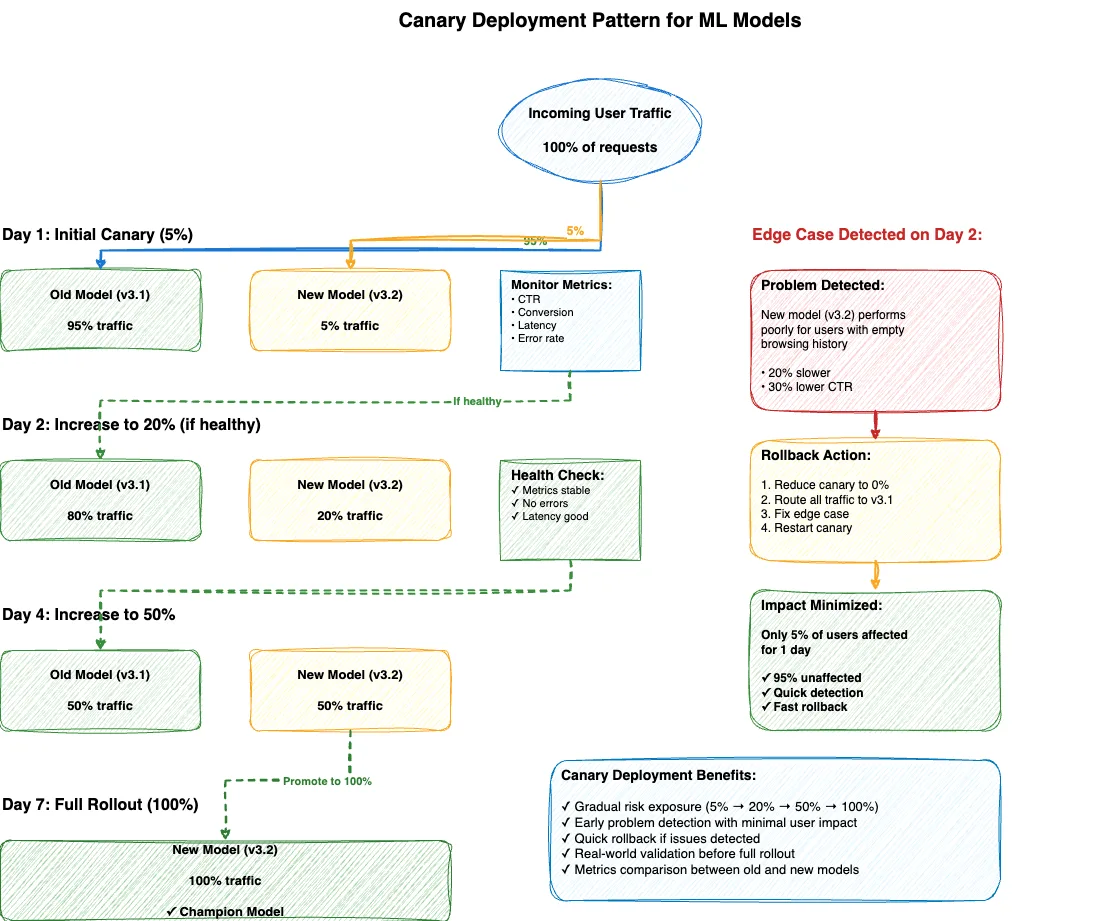
Real-World Example: An e-commerce company deployed a new recommendation engine using a canary strategy:
Day 1: 5% of users see new model recommendations
Monitor: CTR (click-through rate), conversion, latency, error rate
Day 2: If metrics healthy, increase to 20%
Day 4: If still healthy, increase to 50%
Day 7: Full rollout to 100%
This gradual rollout caught an edge case on Day 2: the new model performed poorly for users with empty browsing history (20% slower, 30% lower CTR). They fixed the issue and resumed rollout, avoiding impact to 95% of users.
The Containerization Standard:
Modern MLOps packages models as Docker containers for consistency:
# Dockerfile for model serving
FROM python:3.10-slim

# Install dependencies
COPY requirements.txt .
RUN pip install -r requirements.txt

# Copy model artifact
COPY model.pkl /app/model.pkl

# Copy serving code
COPY serve.py /app/serve.py

# Expose API endpoint
EXPOSE 8000

# Start server
CMD ["uvicorn", "serve:app", "--host", "0.0.0.0", "--port", "8000"]
Benefits:
✅ Reproducibility: Same environment in dev, staging, prod
✅ Portability: Runs on any container runtime (Kubernetes, Docker, AWS ECS)
✅ Isolation: Model dependencies don't conflict with other services
✅ Scalability: Easy to scale horizontally (add more containers)
Common Pitfalls:
❌ Big bang deployment: All users switched to new model at once (no gradual rollout)
❌ No rollback plan: Model breaks, team scrambles to revert
❌ Missing integration tests: Model works in isolation but fails when integrated
❌ Ignoring latency: Model is accurate but too slow for production SLAs
Tools & Technologies:
Containerization: Docker, Kubernetes
Model serving: FastAPI, TorchServe, TensorFlow Serving, KServe, BentoML
Progressive delivery: Argo Rollouts, Flagger, AWS App Mesh
Deployment automation: Argo CD, Flux, GitOps workflows
Cloud services: AWS SageMaker Endpoints, Google Vertex AI, Azure ML
Phase 6: Monitoring & Continuous Feedback
The Question: Is the model still performing well in production, and when should we retrain?
Why It Matters: The world changes. User behavior shifts. Data distributions drift. A model that's 95% accurate today might be 70% accurate in six months—and you won't know unless you're monitoring.
What Happens Here:
Model performance monitoring: Track accuracy, precision, recall over time
Data drift detection: Alert when input data distribution changes
Model drift detection: Alert when model predictions change unexpectedly
Business metric tracking: Monitor revenue, engagement, user satisfaction
Incident response: Investigate and resolve model failures
Retraining triggers: Automatically retrain when performance degrades
Continuous learning: New data flows back to improve the model
Key Deliverables:
Monitoring dashboards (Grafana, CloudWatch, custom)
Drift detection reports
Retraining triggers and automation
The Three Types of Drift:
Drift Type | What Changes | Example | Detection Method |
Input distribution changes | User demographics shift | ||
Relationship between inputs and outputs changes | Fraud patterns evolve | Model performance degradation | |
Label Drift | Output distribution changes | More high-value customers | Output distribution monitoring |
Real-World Example: A credit risk model at a regional bank performed well for two years (AUC consistently 0.87-0.89). Then, during the COVID-19 pandemic, performance dropped to 0.72 within weeks.
What happened?
Data drift: Income distributions changed (unemployment spike)
Concept drift: Relationship between income and default risk changed (government stimulus, forbearance programs)
No monitoring: Team didn't notice until business impact (loan losses increased)
Solution implemented:
Deployed Evidently AI[^4] for automated drift detection
Set up alerts: "If AUC drops below 0.82, trigger retraining"
Created retraining pipeline triggered by alerts
Monitored business metrics (default rate, portfolio risk) alongside ML metrics
Result: Future drift detected within days instead of months, retraining completed automatically within 24 hours.
The Continuous Learning Loop:
Modern MLOps systems close the feedback loop:
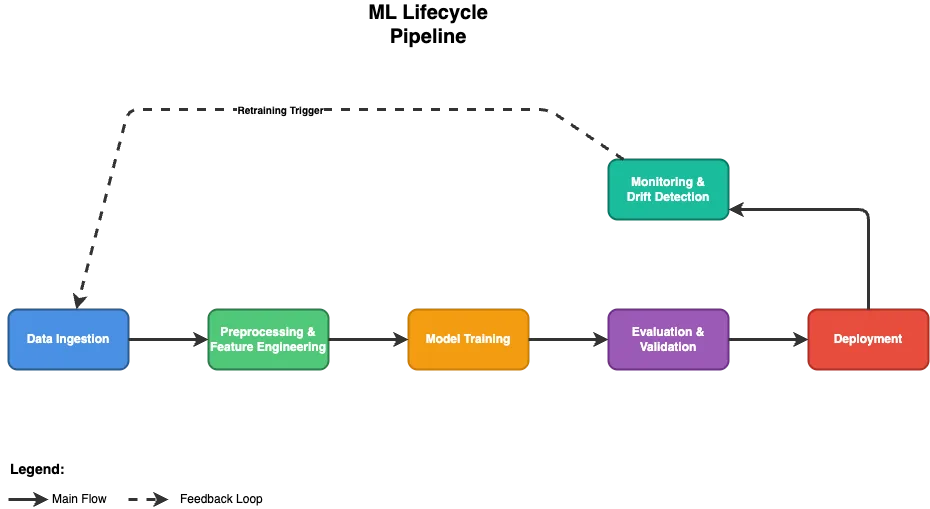
This isn't just automation—it's a living system that improves over time.
Common Pitfalls:
❌ Deploy and forget: No monitoring, drift goes unnoticed for months
❌ Alert fatigue: Too many alerts, team ignores them
❌ Only monitoring uptime: Service is up, but model is making bad predictions
❌ No feedback loop: Production insights don't flow back to training
Tools & Technologies:
Monitoring: Prometheus, Grafana, CloudWatch, Datadog
Drift detection: Evidently AI, Fiddler, WhyLabs, Arize
Model monitoring: AWS SageMaker Model Monitor, Seldon Alibi Detect
Automated retraining: Apache Airflow, Prefect, AWS Step Functions
Why Traditional DevOps Isn't Enough
DevOps revolutionized software delivery with practices like continuous integration, infrastructure as code, and automated testing. But when organizations try to apply DevOps directly to machine learning, they hit fundamental mismatches.
The Three Core Differences
1. Code + Data + Model Versioning
Traditional software: Version code in Git. Reproducibility = same code = same behavior.
Machine learning: Version code + data + trained model. Reproducibility requires:
Git commit hash (code version)
Dataset version (which data was used?)
Hyperparameters (how was it trained?)
Random seed (for stochastic algorithms)
Training environment (library versions, hardware)
Example: "Can you reproduce the Q3 model?" requires answering:
Which training script version? (git commit: abc123)
Which dataset? (DVC version: data-v2.3.1)
Which hyperparameters? (logged in MLflow: lr=0.01, layers=3)
Which environment? (Docker image: model-train:v1.2)
DevOps solution: Git MLOps solution: Git + DVC + MLflow + Docker
2. Testing Isn't Deterministic
Traditional software testing: "Does function X return Y when given input Z?" (deterministic)
Machine learning testing:
"Does the model achieve >85% accuracy on holdout data?" (statistical)
"Does the model have <10% fairness gap across demographics?" (fairness)
"Does the model maintain calibration on edge cases?" (robustness)
"Does the model perform better than the baseline?" (comparative)
Example: A model passes all tests in staging but fails in production because:
Test data distribution doesn't match production (sampling bias)
Model is sensitive to outliers that only appear in production
Model calibration degrades on rare but important edge cases
DevOps solution: Unit tests, integration tests MLOps solution: Statistical validation, fairness tests, drift tests, A/B tests
3. Models Degrade Over Time
Traditional software: Deploy once, runs indefinitely (until you change the code)
Machine learning: Deploy once, degrades continuously (as the world changes)
Example: A recommendation engine trained on 2023 data performs worse in 2024 because:
User preferences evolved (concept drift)
New products launched (data drift)
Seasonal patterns shifted (distribution changes)
DevOps solution: Deploy and monitor uptime MLOps solution: Deploy, monitor drift, retrain continuously
The DevOps-to-MLOps Translation
DevOps Practice | MLOps Adaptation |
Version control (Git) | Version control for code + data + models (Git + DVC + MLflow) |
Continuous Integration | CI + automated model evaluation + fairness tests |
Continuous Deployment | CD + canary deployments + A/B testing |
Infrastructure as Code | Infrastructure as Code + model pipelines as code |
Monitoring (uptime, latency) | Monitoring (uptime + accuracy + drift + business metrics) |
Rollback (previous code version) | Rollback (previous model version + retrain from checkpoint) |
Testing (unit, integration) | Testing (statistical validation + fairness + robustness) |
Key Insight: MLOps isn't "DevOps for ML"—it's DevOps plus data management plus statistical validation plus continuous retraining.
The Three Pillars: CI/CD/CT
Traditional DevOps has two pillars: Continuous Integration and Continuous Deployment. MLOps adds a third: Continuous Training.
Pillar 1: Continuous Integration (CI)
What It Means: Every code change triggers automated testing before merging.
In MLOps:
Code tests: Unit tests for preprocessing, feature engineering, evaluation
Data tests: Schema validation, distribution checks, data quality
Model tests: Performance thresholds, fairness requirements, latency benchmarks
Example CI Pipeline:
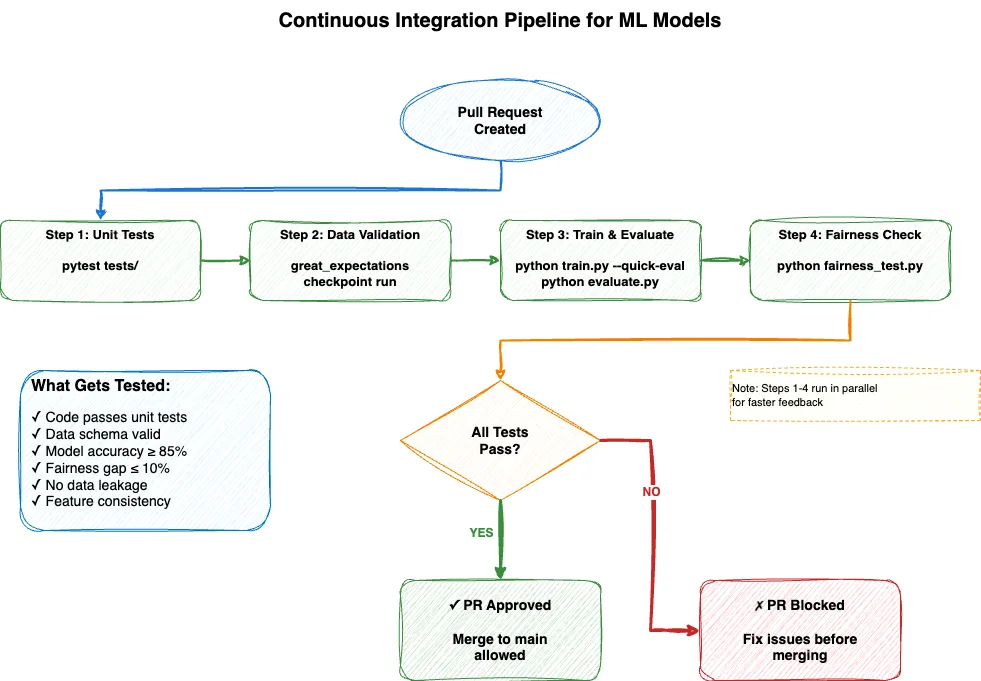
Result: PR blocked if any test fails. No broken models reach main branch.
Pillar 2: Continuous Deployment (CD)
What It Means: Approved changes automatically deploy to production.
In MLOps:
Model packaging: Package trained model as Docker container or artifact
Deployment automation: Deploy to staging → production using canary or blue-green
Approval gates: Require stakeholder approval before production deployment
Rollback automation: Automatically revert if deployment fails health checks
Example CD Pipeline:
# Argo CD application manifest
apiVersion: argoproj.io/v1alpha1
kind: Application
metadata:
  name: fraud-detection-model
spec:
  destination:
    namespace: production
    server: https://kubernetes.default.svc
  source:
    repoURL: https://github.com/company/ml-models
    path: models/fraud-detection
    targetRevision: main
  syncPolicy:
    automated:
      prune: true
      selfHeal: true
    syncOptions:
      - CreateNamespace=true
  # Canary deployment strategy
  strategy:
    canary:
      steps:
        - setWeight: 10
        - pause: {duration: 10m}
        - setWeight: 50
        - pause: {duration: 10m}
        - setWeight: 100
What Gets Deployed:
✅ Staging environment (automated, no approval needed)
✅ Production environment (requires approval + canary deployment)
✅ Rollback triggered if error rate > 5% or latency > 200ms
Pillar 3: Continuous Training (CT)
What It Means: Models automatically retrain as new data arrives or performance degrades.
This is unique to MLOps—traditional software doesn't "retrain" itself.
CT Triggers:
Scheduled: Retrain every week/month (time-based)
Data-driven: Retrain when new data reaches threshold (e.g., 10k new samples)
Performance-driven: Retrain when accuracy drops below threshold
Drift-driven: Retrain when data drift detected
Example CT Pipeline:
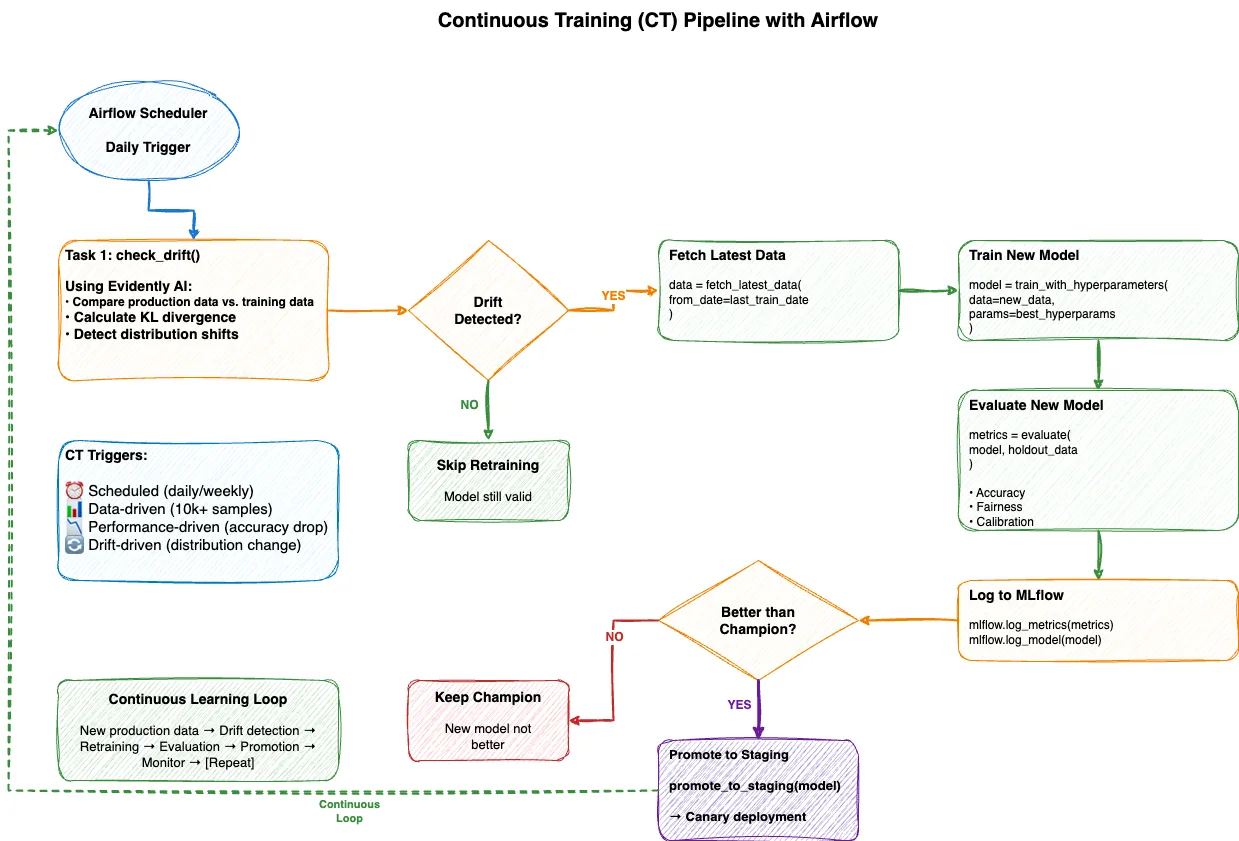
What Happens:
✅ Every day, check if data distribution has drifted
✅ If drift detected, automatically retrain model
✅ If new model better than champion, promote to staging
✅ If staging performance validated, deploy to production (with approval)
Real-World Example: Netflix retrains recommendation models continuously as users watch new content. They don't wait for scheduled retraining—new viewing data triggers retraining for affected models[^5]. This keeps recommendations fresh and relevant.
Governance: Not a Checkbox, But a Foundation
Many organizations treat governance as a post-deployment afterthought: "We'll document everything before the audit." This is backwards.
Modern MLOps embeds governance from the start, making compliance automatic rather than manual.
The Governance Triad: Standards, Tools, Automation
1. Regulatory Standards
Different industries face different requirements:
Industry | Key Regulations | ML-Specific Requirements |
Healthcare | HIPAA, FDA 21 CFR Part 11 | Model validation documentation, patient data protection |
Finance | SOC 2, GDPR, Fair Lending (ECOA) | Model explainability, bias testing, audit trails |
EU (any industry) | EU AI Act, GDPR | Risk assessment, human oversight, right to explanation |
Government | FedRAMP, NIST AI RMF | Security controls, risk management framework |
2. Implementation: The Four Governance Pillars
Pillar A: Data Lineage
Track the journey: raw data → processed data → features → model → predictions
Why: Auditors ask, "Which data was used to train this model?" You must answer definitively.
How: Automated lineage tracking in pipelines:
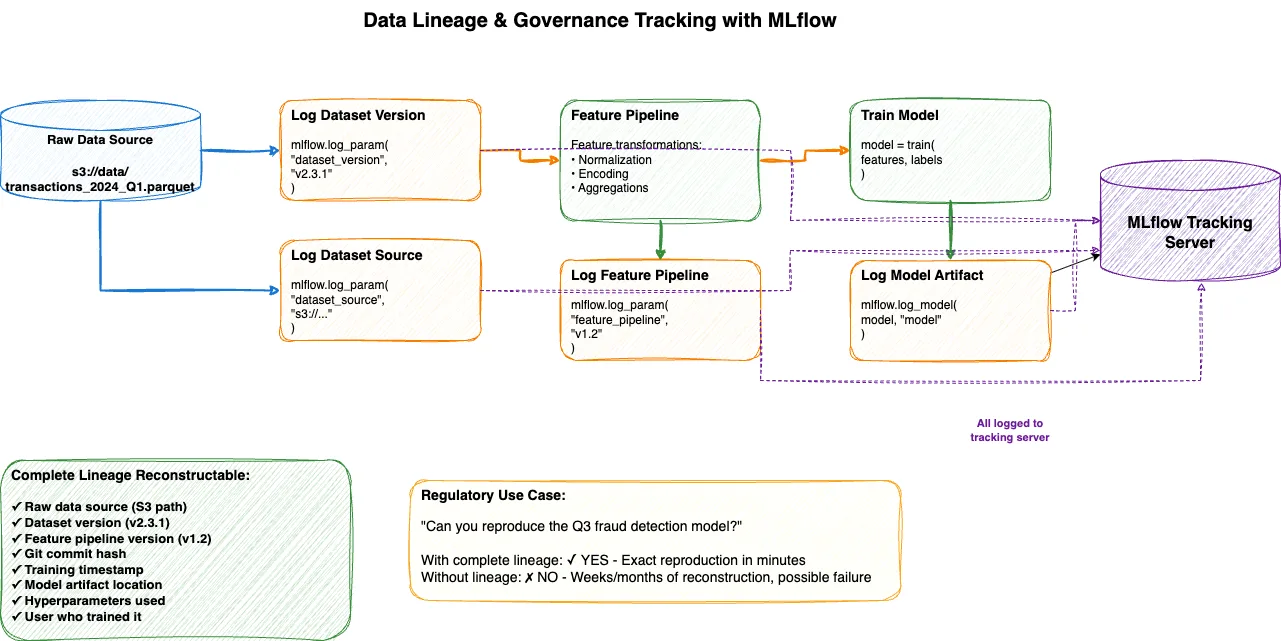
Result: Complete lineage from raw data to predictions, reconstructable years later.
Pillar B: Explainability & Transparency
Stakeholders need to understand why a model made a decision.
Why: Regulatory requirements (EU AI Act), business trust, debugging
How: Generate explanations automatically:
import shap

# Generate SHAP explanations for model
explainer = shap.TreeExplainer(model)
shap_values = explainer.shap_values(X_test)

# Log to MLflow
shap.summary_plot(shap_values, X_test, show=False)
plt.savefig("shap_summary.png")
mlflow.log_artifact("shap_summary.png")
Deliverable: Every model has model card documentation:
What it predicts
Training data sources
Performance metrics
Limitations and biases
Intended use cases
Pillar C: Fairness & Bias Testing
Models must not discriminate based on protected attributes (race, gender, age, etc.).
Why: Legal compliance (Fair Lending, EEOC), ethical responsibility
How: Automated fairness checks in CI/CD:
from fairlearn.metrics import demographic_parity_ratio

# Calculate fairness metric
dpr = demographic_parity_ratio(
    y_true=y_test,
    y_pred=y_pred,
    sensitive_features=X_test['gender']
)

# Fail if unfair
assert dpr > 0.8 and dpr < 1.25, f"Demographic parity violated: {dpr}"
Result: Models cannot deploy if they fail fairness thresholds.
Pillar D: Audit Logging
Every ML operation must be logged for accountability.
Why: Audits, incident investigation, compliance
What to Log:
Who trained the model (user ID, timestamp)
Which data was used (dataset version)
What hyperparameters were chosen
What metrics were achieved
Who approved deployment
When it was deployed
Every prediction made (for high-stakes models)
How: Integrate with audit systems:
# Log to CloudTrail (AWS) or equivalent
audit_log.record({
    'event': 'model_deployment',
    'user': 'alice@company.com',
    'model_id': 'fraud-detection-v3.2',
    'approval_ticket': 'JIRA-1234',
    'deployment_time': '2024-11-05T10:30:00Z'
})
Governance Frameworks to Know
NIST AI Risk Management Framework (RMF)
The U.S. National Institute of Standards and Technology provides a voluntary framework for managing AI risks[^6]:
Govern: Establish governance structure and accountability
Map: Understand context, risks, and impacts
Measure: Test and assess AI systems
Manage: Allocate resources, respond to risks
ISO/IEC 42001: AI Management System
International standard for AI management systems (similar to ISO 27001 for security)[^7]:
Risk assessment and treatment
Data governance
Model lifecycle management
Continuous monitoring and improvement
EU AI Act
Regulates AI systems based on risk level (unacceptable, high, limited, minimal)[^8]:
High-risk systems (hiring, credit scoring, law enforcement): Strict requirements
Requirements: Human oversight, transparency, accuracy, robustness, data governance
How mCloud Technology Can Help
MLOps Strategy & Implementation Services
At mCloud, we help organizations build governance-first MLOps capabilities that deliver business value while meeting regulatory requirements.
Our Approach:
Assessment: Understand your current state, regulatory requirements, and business goals
Strategy: Design MLOps architecture aligned with your maturity level and industry
Implementation: Build pipelines, governance automation, and monitoring systems
Enablement: Train your teams on MLOps best practices and tools
What You Get:
End-to-end MDLC implementation (all 6 phases)
Governance automation (audit logging, lineage tracking, fairness testing)
Tool selection and deployment (MLflow, feature stores, monitoring)
Team training and documentation
Industries We Serve: Healthcare | Financial Services | Manufacturing | Retail | Government
Case Study: We helped a pharmaceutical company implement FDA-compliant MLOps for clinical trial modeling. They needed complete model reproducibility and audit trails for regulatory submissions.
Solution: We implemented:
Versioned data pipelines (DVC)
Automated model cards and lineage tracking (MLflow + custom tooling)
Fairness testing integrated into CI/CD
Audit logging for all model operations
Result: FDA submission completed 4 months faster than previous manual process, with zero compliance gaps.
The MLOps Ecosystem: Tools You Should Know
The MLOps ecosystem has exploded in recent years. Here's a curated guide to essential tools, organized by MDLC phase.
Data & Feature Management
Feature Stores: Feast (OSS), Tecton, Hopsworks, AWS SageMaker Feature Store, Google Vertex AI Feature Store
Data Versioning: DVC, Delta Lake, Apache Iceberg, Pachyderm
Data Quality: Great Expectations, Deequ, TensorFlow Data Validation
ETL/Orchestration: Apache Airflow, Prefect, Dagster, AWS Glue
Experimentation & Training
Experiment Tracking: MLflow (most popular OSS), Weights & Biases, Neptune.ai, Comet
Training Frameworks: Scikit-learn, TensorFlow, PyTorch, XGBoost, LightGBM
Distributed Training: Ray, Horovod, PyTorch Distributed
Model Evaluation
Fairness: Fairlearn, AIF360, AWS SageMaker Clarify
Explainability: SHAP, LIME, InterpretML
Robustness: Deepchecks, Alibi Detect
Deployment & Serving
Model Serving: FastAPI (custom), TorchServe, TensorFlow Serving, KServe, BentoML, Seldon Core
Containers & Orchestration: Docker, Kubernetes, Helm
Progressive Delivery: Argo Rollouts, Flagger
Monitoring & Observability
Drift Detection: Evidently AI, Fiddler, WhyLabs, Arize
Monitoring: Prometheus, Grafana, Datadog, CloudWatch
Model Monitoring: AWS SageMaker Model Monitor, Seldon Alibi Detect
Cloud Platforms
AWS: SageMaker (end-to-end ML platform)
Google Cloud: Vertex AI
Azure: Azure Machine Learning
Databricks: Unified data + ML platform
Success Metrics: What Good Looks Like
How do you know if your MLOps practices are working? Measure these key metrics:
Operational Metrics
Metric | Level 0 (Manual) | Level 1 (Repeatable) | Level 2 (Defined) | Level 3+ (Managed) |
Time to Production | 4-12 weeks | 1-2 weeks | 3-5 days | Hours to 1 day |
Deployment Frequency | Monthly | Weekly | Daily | Multiple per day |
Deployment Success Rate | 50-70% | 80-90% | 95%+ | 99%+ |
Model Reproducibility | < 50% | 80-90% | 100% | 100% |
Experiment Velocity | 1-2/data scientist/week | 5-10/week | 10-20/week | 20-50+/week |
Business Metrics
Metric | How to Measure | What Good Looks Like |
ML ROI | (Business value - ML costs) / ML costs | > 200% in Year 2 |
Model Uptime | % time model available and accurate | > 99.9% |
Incident Response Time | Time from alert to resolution | < 1 hour |
Feature Reuse | % features used by multiple models | > 30% (reduces redundant work) |
Governance Compliance | % models with complete documentation | 100% (non-negotiable) |
Team Satisfaction Metrics
Metric | How to Measure | Target |
Data Scientist Satisfaction | Survey: "Can you easily deploy models?" | > 4/5 |
Stakeholder Trust | Survey: "Do you trust ML model decisions?" | > 4/5 |
Platform Adoption | % of models using MLOps platform | > 80% |
Conclusion: From Chaos to Systematic Excellence
Machine learning is powerful, but without systematic practices, that power is wasted—or worse, dangerous.
The organizations that succeed with ML aren't the ones with the best algorithms. They're the ones with the best systems for developing, deploying, and maintaining those algorithms over time.
That's what MLOps provides: a transformation from:
Notebooks → Production systems
Experiments → Repeatable processes
One-off models → Continuous learning systems
Hope → Confidence
The journey starts with fundamentals. You now have them.
The next step is building your first end-to-end pipeline. Join us in Article 2 to learn exactly how.
References & Further Reading
[^1]: Great Expectations: Data Quality Testing Framework
[^2]: Feast: Open Source Feature Store
[^3]: Fairlearn: Fairness Assessment and Mitigation Toolkit
[^4]: Evidently AI: ML Model Monitoring and Drift Detection
[^5]: Netflix Technology Blog: Continuous Learning at Netflix
[^6]: NIST: AI Risk Management Framework
[^7]: ISO/IEC 42001: AI Management System Standard
[^8]: European Commission: EU AI Act
Additional Resources:
Google's Rules of Machine Learning - Best practices for ML engineering
AWS Machine Learning Lens (Well-Architected Framework) - Architecture guidance for ML workloads
Microsoft's Responsible AI Standard - Framework for responsible AI development
MLOps Community - Slack, events, and resources
Machine Learning Mastery - Tutorials and guides on ML concepts
Made With ML - MLOps best practices and tutorials
Papers With Code - ML research papers and implementations
DVC Documentation - Complete guide to data versioning
MLflow Documentation - Experiment tracking and model management